
Indiana Once Led the Nation on Tobacco Control.
What happened, and what was the cost? This is a story of political will, budget cuts, and a public health opportunity waiting to be reclaimed.
There was a moment, not long ago, when Indiana was doing something genuinely rare in public health: it was winning. In the early 2000s, the state ran bold, adult and youth-driven campaigns that didn't moralize — they agitated. Rather than warning teenagers that smoking was bad for their health, Indiana's counter-marketing attacked the tobacco industry directly, channeling youth rebellion against the companies manipulating them.
The campaigns were edgy, confrontational, and rooted in a simple insight: teenagers don't respond to lectures; they respond to a cause. Cigarette use dropped. Smoke-free environments expanded. And Indiana stood among only six states in the entire country meeting the CDC's recommended investment level for tobacco prevention. Then the money was cut. Or more precisely, it was redirected.
The Rise: Building Something That Worked
The Indiana Tobacco Prevention and Cessation Agency (ITPC) was established in 2000 as an independent agency, funded at approximately $35 million per year from tobacco industry Master Settlement Agreement dollars. That independence was important. The agency had its own board, its own mandate, and the political insulation to take creative risks that a standard government health department would avoid.
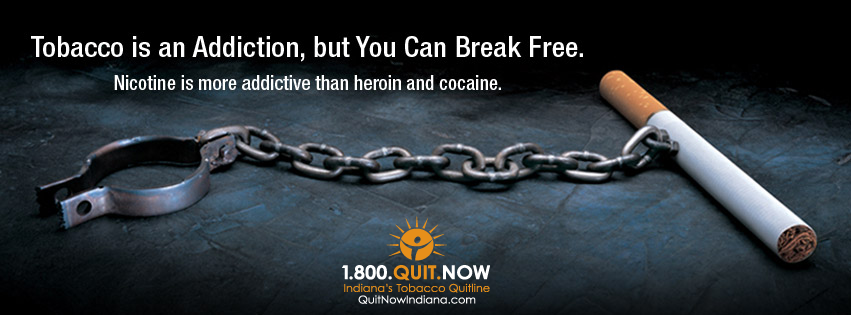
What it built was comprehensive, county coalitions, minority outreach programs, counter-marketing campaigns, and cessation services like the Quit Now Indiana hotline (1-800-QUIT-NOW), which provided free coaching and nicotine replacement therapy to anyone who called. The program can serve residents as young as 13, prioritizing high-risk populations including pregnant individuals and Medicaid recipients, and aligning every initiative with CDC best practices.
The results were tracked. Adult and Youth smoking declined. The campaigns earned national attention. Indiana, a conservative state, was setting a standard that many states were struggling to match.
The Fall: A Budget Decision with Lasting Consequences
In 2005, Indiana legislators forced a budget cut and big changes. The solution, as it often is in state government, involved raiding funds and redirecting the money to something else. ITPC's budget was cut by more than 60%. Over the following years, those cuts compounded. By 2019, total prevention funding had fallen more than 78% from early 2000s levels.
The money wasn't eliminated — it was quietly diverted to close budget gaps and fund other state priorities. It was the kind of decision that rarely generates headlines in the year it happens but reshapes public health outcomes for a generation.
The structural blow came in 2011, when the legislature abolished ITPC's independent executive board entirely, folding tobacco control into the Indiana State Department of Health. Advocates describe the merger as the end of the program's autonomy. Inside a large agency with many competing priorities, tobacco prevention lost its dedicated leadership, its risk tolerance, and its creative freedom.
The Current State of the State
The numbers are stark. Indiana currently spends approximately $10.9 million per year on tobacco prevention — roughly 14.9% of the CDC's recommended $73.5 million. National advocacy groups consistently give the state failing grades on both prevention funding and tobacco tax policy in their annual "State of Tobacco Control" reports.
Indiana's cigarette tax sits just under $1.00 per pack and hasn't been raised since 2007. Leading states have taxes above $4.00 — a meaningful deterrent, particularly for young people and price-sensitive smokers. The gap isn't just symbolic. Price increases are among the most evidence-based tools in tobacco control, and Indiana has left that lever untouched for nearly two decades.
The cumulative effect: a state that once resembled a national model now resembles the lower-performing southern states that tobacco control advocates use as cautionary examples.
Why Great Campaigns Matter
For anyone who remembers Indiana's early 2000s campaigns, the contrast with today's messaging is striking. The current approach relies heavily on national assets — CDC's "Tips From Former Smokers," FDA's "The Real Cost," updated truth® creative — supplemented by general health messaging about disease burden and cost. The content is accurate. It is also safe, predictable, and largely indistinguishable from what you'd see in any other mid-sized state.
The shift isn't accidental. Counter-marketing budgets in Indiana were cut by roughly 80% between 2002 and 2010. With less money comes less ability to produce original, high-risk creative. With less independence comes more pressure to avoid controversy. Aggressive anti-industry campaigns can generate complaints from legislators, stakeholders, or industry-aligned groups — and an underfunded program operating inside a larger department has limited appetite for that fight.
The result is messaging that checks boxes without moving needles. Research consistently shows that confrontational, anti-industry campaigns — the kind Indiana used to run — produce faster declines in youth smoking than health-risk PSAs. The evidence didn't change. The political and financial environment did.
The Overlooked Business Case
Tobacco control is sometimes framed as a social issue, but it is also a straightforward economic argument. Tobacco use costs Indiana billions annually in healthcare expenditures and lost workforce productivity. Every dollar invested in evidence-based cessation and prevention programs generates a documented return — not over decades, but within years — through reduced hospitalizations, lower Medicaid costs, and a healthier labor force.
Quit Now Indiana, the state's free cessation coaching service, is among the most cost-effective public health tools available. Nicotine replacement therapy and telephone coaching have strong clinical evidence behind them. These aren't speculative interventions — they are proven, and they are chronically underutilized because the program lacks the funding to market them aggressively.
For Indiana employers, this matters directly. Employees who smoke cost more in health insurance claims, take more sick days, and are more likely to experience chronic conditions that reduce long-term productivity. A state that invested seriously in cessation support would be, in part, subsidizing a healthier workforce for every business operating within its borders.
The Importance of Independence and Leadership
Indiana didn’t lose ground because its tobacco control program failed—it lost ground due to three specific, reversible decisions: funding was cut and redirected, the independent agency was dissolved, and aggressive leadership was absent. Reclaiming a leadership position would require reversing at least some of those decisions.
Restoring funding, even partially toward the recommended level, would allow Indiana to rebuild a strong program across all 92 counties, expand cessation services, and invest in bold, targeted counter-marketing that truly changes behavior. Returning meaningful independence to the agency would give it the freedom to take the creative risks that made it successful.
In 2025, the Indiana legislature passed a budget that included the first cigarette tax increase in nearly two decades, raising it to a competitive level and creating the perfect opportunity to strengthen the program. This move would immediately reduce consumption and the state’s health burden. None of this is conceptually complicated; what’s required is the political will that has been missing since 2005.
The Opportunity is Now
Indiana had a model that worked. It has the infrastructure, however diminished, still in place. It has a proven cessation service in Quit Now Indiana that could reach far more Hoosiers with adequate marketing support. It has data showing exactly where it fell behind and why.
What it lacks is strong leadership and political support. Tobacco control rarely feels like an urgent crisis, making it easy to postpone. But the cost of delay is very real—measured in cancer diagnoses, hospitalizations, premature deaths, and economic drag, quietly increasing the burden on communities across the state year after year. Indiana did this before well enough that the rest of the country noticed. The question is whether anyone in a position to act is paying attention.
Effective counter-marketing campaigns take many forms and engage multiple aspects of the community. Here’s a look back in time: https://bit.ly/CampaignsThatWorks